
Fujian Travel Guide
Fujian, the land of prosperity since ancient Chinese history, is located in southeast of China, with Fuzhou as the capital. Surrounding provinces around Fujian are Zhejiang in the north, Jiangxi in the west, Guangdong in the south and Taiwan Straits in the east. Fujian occupies an area of 121,400 square kilometres (46,872 square miles), with population more than 35 million. Blend of scenic spots, rich histories, and famous ancient architectures makes Fujian Province as a prime destination in South China region.
Fujian also called "Min" refer to the ancient Minyue kingdom; The Hok-kian, Hokkien, Fukien, Foukien, Fuk-kian, Fuchien, and Hok-giong are another name of this province. The word "Fujian" named during the Tang Dynasty, which is comes from combination of Fuzhou and Jian'ou; both of them are city's name in Fujian.
Fujian Province is mainly mountainous, with northwest area has higher altitude. Wuyi Mountains which is located in Nanping region forming border between Fujian and Jiangxi Province. Huanggang Peak (2157m) in the Wuyi Mountains is the highest point in the province. Fujian coastal territories faces South China Sea to the south, East China Sea in the east, and the Taiwan Strait in the southeast. The River Min cuts the land in northern and central Fujian.
The charm of Fujian will be an unforgettable moment for the travelers, from wonderful scenery area of Wuyi Mountain, ancient ports of Fuzhou and Quanzhou, travel to Hakka homeland to adore Hakka Tulou, visiting Xiamen which has unique combination of modern lifestyle and historical value, or just relax and enjoying the famous Fujian tea. Fujian has mild warm temperature due to its location in subtropical zone, so it is suitable to visit Fujian in all season.
Fujian Cities
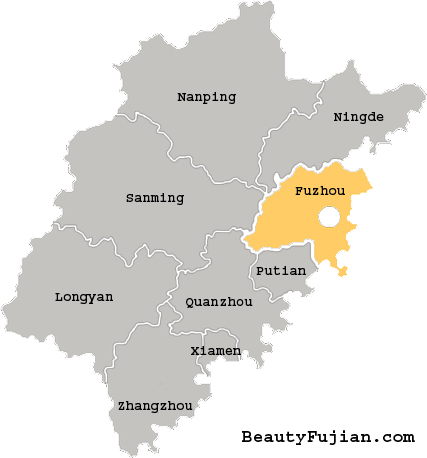
Fujian cities divided into nine prefecture-level divisions as follow :
- Fuzhou
- Longyan
- Nanping
- Ningde
- Putian
- Quanzhao
- Sanming
- Xiamen
- Zhangzhou
Fujian Airports
List of airports in Fujian Province, People Republic of China- Changle International Airport in Fuzhou
- Gaoqi International Airport in Xiamen
- Wuyishan Airport in Nanping
- Jinjiang Airport in Quanzhao
- Longyan Airport
Fujian Popular Tourist Destinations
- Wuyi Mountain (Wuyishan), is the most popular destination for Fujian travelers, offering incredible landscapes, legends and bamboo rafting adventure.
- Located southwest of Xiamen, Gulangyu Island (also known as "Garden on the Sea") is a wonderful island covered with trees and flowers.
- Situated near Putian City, Meizhou Island considers as scenic and religious destination since Mazu (Goddess of the Sea) were worshipped there.
- The majority of population in Fujian are descendant of Han people, which is have sub ethnic called The Hakka. Originally living in northern China, The Hakka began migrating southern China in the 13th century. During their migration, they weren't always welcomed, so they built round house to protect their family from enemies. Today, their unique architectures attracts many travelers, and the famous one is Hakka Round Houses in Yongding. The Hakka Round Houses now become icon of historic architecture in Fujian.
- Built during the Tang dynasty, South Putuo Temple is a sacred place for Buddist. This temple located at the foot of Five Old Men Hill (Wulaoshan), southern part of Xiamen.
- Another exotic Buddist temple is Kaiyuan Monastery in Quanzhou. Built in the second year of the reign of Emperor Chuigong from Tang dynasty, this temple is one of the largest Buddist architecture in Fujian Province.